Event-Driven Salesforce: Reducing Coupling Without Losing Control
But how do you maintain visibility and governance when systems operate autonomously?
The Integration Paradox
The standard advice for building scalable integration architectures is to reduce coupling. Make systems independent. Let them operate asynchronously. Stop building webs of synchronous dependencies that turn one system’s outage into everyone’s problem.
But there is a reason organizations resist this advice: loose coupling feels like losing control.
When Salesforce directly calls an ERP to create an order and waits for confirmation, you know immediately if something failed. When Salesforce publishes an event and moves on, you have to trust that downstream systems are listening, processing correctly, and handling errors appropriately. That trust does not come naturally to teams who have spent years debugging integration failures.
This tension—between the architectural benefits of event-driven integration and the operational need for visibility and control—is the real challenge in adopting Platform Events. The technology is straightforward. The organizational shift is harder.
From my experience implementing event-driven architectures across enterprise Salesforce programs, the key is recognizing that “reducing coupling” and “maintaining control” are not opposing goals. They require different mechanisms, but both are achievable in the same system.
How Tight Coupling Creates the Illusion of Control
Most tightly coupled integration architectures were not designed that way intentionally. They evolved from sensible decisions made at smaller scale. Salesforce needs to create an ERP order when a deal closes, so someone builds a synchronous API call. Salesforce needs to update the data warehouse, so someone adds another API call. Need to notify billing? Another callout. Each decision is rational in isolation.
The problem emerges at scale. Every new requirement adds another dependency. Every downstream system becomes something Salesforce must wait for, coordinate with, or handle errors from. What started as “control” becomes a bottleneck where Salesforce orchestrates distributed transactions across systems that were never designed to operate in lockstep.
I worked with an Insurance client where their Sales operations made synchronous callouts to different systems. On a good day, this might have added three seconds of latency to the user experience. During peak enrollment periods, when one or more systems experienced load, the entire sales funnel system failed. Sales reps could not close deals because Salesforce was waiting on systems two or three hops away.
The organization believed this architecture gave them control because every transaction was coordinated and confirmed. But the control was illusory. When any downstream system had issues, the entire business process stopped. Dependencies that were supposed to provide safety instead created fragility.
The Real Cost: Coordination Overhead
Tightly coupled systems also create hidden coordination costs. When any team wants to change how their system processes data from Salesforce, they must coordinate with Salesforce administrators, test the integration end-to-end, and deploy changes in lockstep. A simple billing system enhancement becomes a multi-team project because the integration assumes perfect synchronization.
This coordination overhead compounds as the integration landscape grows. Adding a new system means Salesforce must be modified to call it. Changing a data model means updating every integration that touches that data. The architecture that promised control becomes a change management bottleneck that slows the entire organization.
Platform Events: Trading Coordination for Contracts
Event-driven integration with Platform Events offers a different model. Instead of Salesforce coordinating downstream actions, it publishes facts about what happened. Systems that care about those facts subscribe to the event stream and react independently.
An API call is a command: “Create this order now, and tell me if it worked.”
A Platform Event is a notification: “This deal closed. Here are the details.”
This shift eliminates the coordination dance. Salesforce does not call each system or wait for responses. Downstream systems do not poll Salesforce for changes. Instead, Salesforce broadcasts business events, and subscribers handle them on their own timeline.
But this raises the central question: if Salesforce is not orchestrating these processes, how do you maintain control?
The answer is that you trade coordination for contracts. In a tightly coupled architecture, control comes from synchronous transaction management. In an event-driven architecture, control comes from well-defined event schemas, monitoring, and governance around how subscribers process events.
What “Control” Looks Like in Event-Driven Architecture
Control in an event-driven system manifests differently than in tightly coupled integrations, but it is no less real:
Event Schema as Contract: When Salesforce publishes a Deal Won event, the structure and meaning of that event becomes a contract with all subscribers. The schema defines what data is available and what it represents. Subscribers depend on this contract remaining stable. This is control through standardization rather than orchestration.
Monitoring Event Processing: Rather than getting immediate confirmation that an ERP order was created, you monitor that the ERP subscriber processed the event successfully. Dashboards show event publication rates, subscriber lag, and processing failures. This is control through observability rather than synchronous feedback.
Replay and Recovery: If a subscriber fails or falls behind, it can replay missed events within a 24-hour window. This is control through resilience—subscribers recover from failures without manual intervention or data reconciliation.
Autonomous Error Handling: Each subscriber implements its own error handling logic. If the ERP cannot create an order because inventory is not available, the ERP retries, logs an alert, or escalates—without impacting other subscribers or requiring Salesforce intervention. This is control through isolation rather than centralized exception handling.
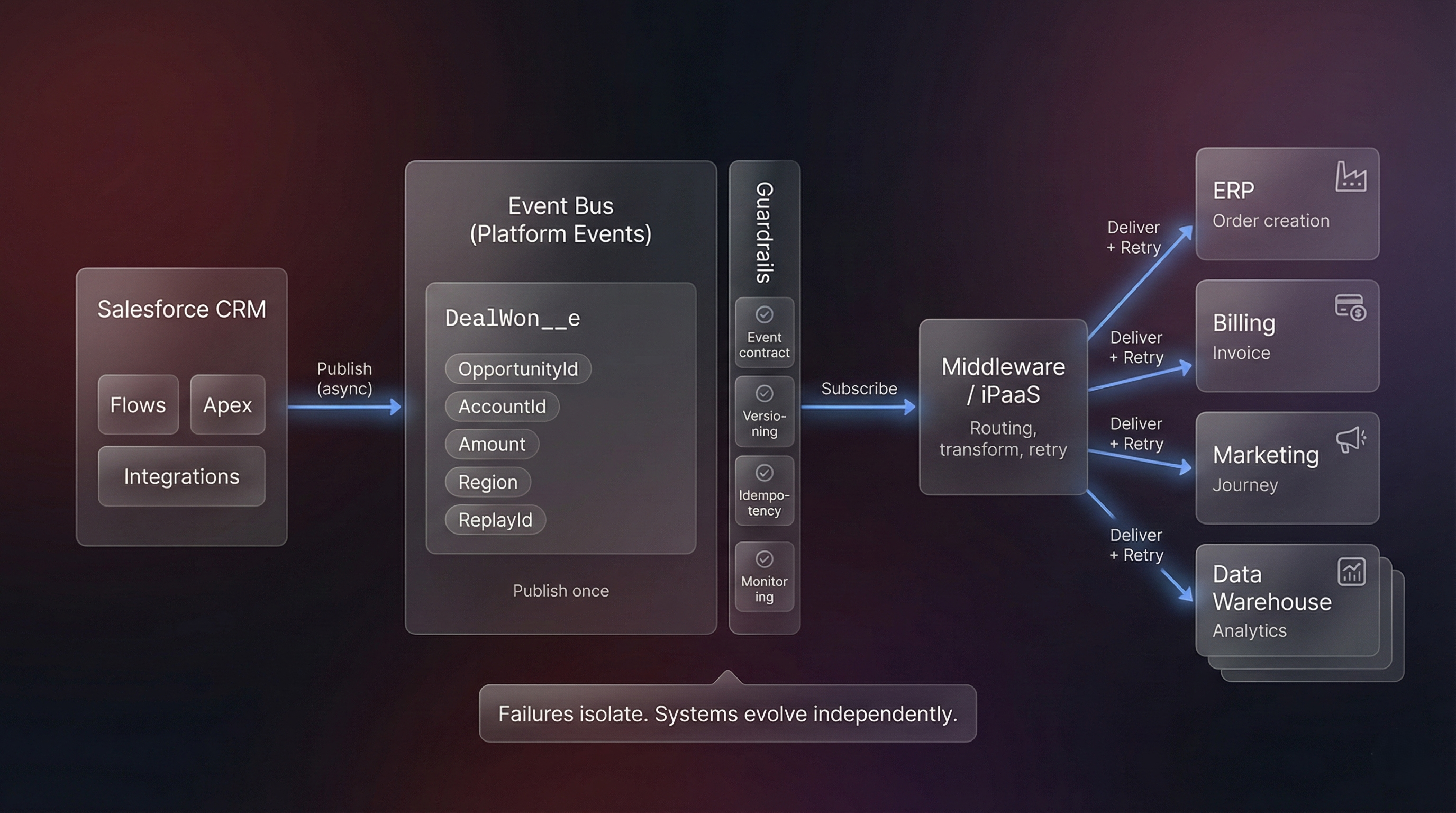 Event-driven architecture with governance mechanisms: contracts, versioning, idempotency, and monitoring provide control without tight coupling
The shift is from “Salesforce orchestrates and confirms each step” to “Salesforce publishes events, subscribers process them, and the organization monitors outcomes.” Both provide control, but event-driven control scales without creating bottlenecks.
Practical Governance: How to Maintain Visibility
The biggest operational question when moving to event-driven integration is: “How do we know if something goes wrong?”
In synchronous architectures, failures are immediate and obvious. A callout fails, an error message appears, someone investigates. In asynchronous architectures, failures can be silent. An event is published, no subscriber processes it, and no one notices until a customer complains that their order is missing.
This risk is real, but it is solvable through deliberate governance mechanisms.
Event Monitoring and Alerting
Salesforce provides Event Monitoring capabilities that track how many events are published and delivered. For production systems processing critical business events, teams should monitor:
Publication Rate: Are events being published at the expected volume? A sudden drop might indicate a broken trigger or process.
Delivery Lag: Are subscribers keeping up with the event stream, or are they falling behind? Increasing lag suggests a subscriber is overwhelmed or failing.
Subscriber Health: Is each known subscriber connected and processing events? Disconnected subscribers should trigger alerts so teams can investigate before data loss occurs.
At one financial services client, we implemented a monitoring dashboard that showed real-time status of all critical event subscribers. When the billing system’s subscriber disconnected due to a deployment issue, the dashboard alerted the team within minutes. They reconnected the subscriber and used the replay mechanism to catch up on missed events before any invoices were delayed.
End-to-End Transaction Tracking
For business-critical processes, implement correlation IDs that flow through the entire event chain. When Salesforce publishes a Deal Won event, include a unique transaction ID. The ERP logs this ID when creating an order. Billing logs it when generating an invoice. Analytics logs it when recording the transaction.
With correlation IDs, you can trace an entire business process across systems without requiring synchronous confirmation. If a customer reports a missing order, you can query logs across all systems using the transaction ID to determine where the process failed. This provides end-to-end visibility without tight coupling.
Schema Versioning and Backward Compatibility
One of the biggest control challenges in event-driven systems is managing schema changes. If Salesforce changes the structure of a Deal Won event, all subscribers must handle the change gracefully.
The governance mechanism here is treating event schemas as contracts with versioning and backward compatibility guarantees. Adding new fields to an event is safe—subscribers that do not need the data simply ignore it. Removing or renaming fields breaks the contract and requires coordinating with all subscribers.
In practice, this means:
Additive changes are safe: You can add new fields to an event without breaking subscribers.
Breaking changes require coordination: Removing fields, changing data types, or altering field meanings requires a migration plan where subscribers update their logic before Salesforce changes the event.
Version indicators help: Some teams include a schema version number in the event payload, allowing subscribers to handle different event versions gracefully during transitions.
This is more deliberate than the ad-hoc changes common in tightly coupled systems, but the discipline pays off in reduced coordination overhead and fewer integration failures.
Implementation Patterns That Preserve Control
Moving from theory to practice, several implementation patterns help organizations maintain control while adopting event-driven integration.
Start With High-Impact, Low-Complexity Events
The first Platform Event implementation should be straightforward enough to validate the pattern without introducing excessive risk. Good candidates are events where:
Immediate confirmation is not required: Deal won events, customer milestones, or status changes where downstream processing can happen asynchronously.
Multiple systems need the same information: Order processing, customer onboarding, or lead conversion where multiple subscribers benefit from the same event.
Existing integration creates bottlenecks: Synchronous callouts that slow user experience or create cascading failures when downstream systems are unavailable.
One pattern I have seen work well is starting with order confirmation events. When a deal closes in Salesforce, publish an Order Confirmed event. Subscribe the ERP and billing systems. Keep existing synchronous integrations as a backup while validating that the event-driven approach works. Once confidence is established, decommission the old integrations and expand to other event types.
Idempotent Subscribers Are Non-Negotiable
Because Platform Events can occasionally deliver duplicates or arrive out of order, subscribers must be idempotent—processing the same event twice produces the same result as processing it once.
In practice, this usually means checking whether an action has already been taken before performing it. If an Order Confirmed event arrives and an order with that ID already exists in the ERP, skip creation rather than creating a duplicate. This requires including unique identifiers in event payloads and designing subscribers with defensive logic.
This discipline actually improves reliability compared to tightly coupled systems, where transient failures often result in duplicate or incomplete processing that requires manual cleanup. Idempotent subscribers handle these edge cases automatically.
Implement Circuit Breakers for Downstream Dependencies
Even though subscribers operate independently, they still have their own dependencies. If a subscriber calls another system’s API to process an event, that dependency can fail. Without proper error handling, a downstream outage can cause events to pile up unprocessed.
The circuit breaker pattern helps here. When a subscriber detects repeated failures calling a downstream system, it stops attempting calls temporarily, logs the issue, and alerts operations. Events can be queued for retry once the downstream system recovers. This prevents cascading failures and provides visibility into where problems exist.
At a manufacturing client, we implemented circuit breakers in the ERP subscriber that processed order events. When SAP experienced a brief outage, the subscriber detected the issue, stopped attempting calls, and sent an alert. Operations saw the alert, confirmed SAP was recovering from planned maintenance, and the subscriber automatically resumed processing once SAP was available. No orders were lost, and the issue was resolved without manual intervention.
Create Observability Dashboards Before Going Live
Control requires visibility. Before decommissioning synchronous integrations in favor of event-driven patterns, build dashboards that show system health. At minimum, track:
Events published per hour: Baseline for normal volumes and detection of anomalies.
Subscriber lag: How far behind each subscriber is in processing the event stream.
Error rates: How often subscribers encounter processing failures.
Replay usage: When subscribers use replay to catch up, indicating they fell behind or disconnected.
These metrics provide the operational visibility that replaces the immediate feedback of synchronous integrations. Teams gain confidence in the event-driven approach when they can see that subscribers are healthy, processing events reliably, and recovering automatically from transient failures.
When Event-Driven Architecture Is Not the Right Answer
Platform Events are powerful, but they are not universal. Understanding where they do not fit is as important as understanding where they excel.
Synchronous validation requirements: If a business process requires confirming that a downstream action succeeded before proceeding, a synchronous API call is more appropriate. For example, validating inventory availability before closing a deal requires an immediate response that an event-driven approach cannot provide.
Strict transactional consistency: Because Platform Events are published even if the Salesforce transaction rolls back, there is a risk of sending events for actions that did not complete. If strict transaction consistency is required across Salesforce and external systems, a different integration pattern may be necessary.
Simple point-to-point scenarios: If only one system needs to know about a Salesforce change and the integration is stable, a direct API call may be simpler than introducing event infrastructure. Platform Events provide the most value when multiple systems need the same information or when tight coupling creates operational problems.
The right integration architecture usually combines multiple patterns. Use Platform Events for broadcasting business events to multiple systems. Use synchronous APIs when immediate feedback is required. Use batch processes for large data migrations. The goal is not to eliminate other integration methods but to use each where it provides the most value.
Measuring Success: What Changes
The success of event-driven integration is measurable in both technical and business metrics.
Reduced latency in Salesforce transactions: When Salesforce stops waiting for downstream systems, user experience improves. One client saw average page load times decrease by 40% after removing synchronous ERP callouts from their opportunity close process.
Improved system availability: Downstream outages no longer cascade to Salesforce. If billing is down, the ERP still receives order events and Salesforce users continue working. Overall system availability increases because failures are isolated.
Faster integration implementation: Adding new subscribers to existing events takes hours rather than weeks. A new system can subscribe to Deal Won events without requiring changes to Salesforce or coordination with other subscribers.
Decreased coordination overhead: Teams spend less time coordinating integration changes because event contracts provide loose coupling. A billing system upgrade no longer requires Salesforce regression testing if the event schema remains stable.
But the most important change is cultural. Teams stop viewing integration as a source of operational risk and start seeing it as a scalable capability. When a new business requirement emerges that requires Salesforce data in another system, the question shifts from “How long will it take to build this integration?” to “Which event should we subscribe to?”
The Path Forward: Incremental Adoption
Organizations do not need to rearchitect their entire integration landscape to benefit from event-driven patterns. The approach works well when adopted incrementally.
Start with one high-value use case where tight coupling creates visible problems—order processing, customer onboarding, or lead-to-opportunity conversion. Implement a single Platform Event and subscribe one or two critical systems. Build monitoring dashboards and validate that the pattern works in production.
Once the team gains confidence, expand to additional event types and subscribers. Let new systems subscribe to existing events rather than building new point-to-point connections. Over time, the integration architecture shifts from a web of dependencies to a hub-and-spoke model where Salesforce publishes business signals and systems react independently.
The long-term goal is an integration architecture that scales with business complexity rather than becoming more fragile. That is the promise of event-driven Salesforce—not eliminating control, but redefining what control means in a distributed system.
Control is not about orchestrating every step synchronously. It is about defining clear contracts, monitoring outcomes, and building systems that recover gracefully from failures. Event-driven integration provides all of this while eliminating the brittleness that comes from tight coupling.
Implementing event-driven integration in your Salesforce environment? I’d welcome a conversation about your specific architecture challenges. Connect with me on LinkedIn