When Words Drift: Language and Misalignment in Enterprise Delivery
Part 1 of 3. How shared terms quietly change meaning across strategy, planning, and execution.
A Pattern Many Teams Recognize
“What are the requirements?”
It sounds like a simple question. In practice, it often produces five different answers depending on who you ask:
- Product manager: “User stories in the backlog”
- Business analyst: “The BRD we circulated last month”
- Engineer: “The Jira tickets with acceptance criteria”
- Executive: “What we agreed to in the business case”
- Legal: “The contractual commitments in the SOW”
They’re all correct. And that’s exactly where misalignment begins.
Enterprise initiatives operate in a constant state of translation. Terms shift meaning across departments, delivery phases, and organizational contexts. A single word like “requirements” can refer to strategic objectives, functional expectations, user needs, or acceptance criteria, depending on the altitude at which it’s used.
This isn’t just semantic nitpicking. It’s one of the reasons initiatives stall, teams build the wrong thing extremely well, and stakeholders walk away feeling unheard despite months of documentation and meetings.
Why This Matters More Than Ever
This translation challenge isn’t disappearing. If anything, it’s becoming more visible.
Traditional enterprises are adopting Agile without fully retiring waterfall-era governance. Agile-native organizations are scaling and introducing compliance and risk controls. AI initiatives demand business context that technical teams don’t naturally possess. Remote work has removed the informal clarification loops that once resolved ambiguity in real time.
A familiar pattern tends to emerge. Business leaders describe outcomes in strategic language. Product teams translate those outcomes into capabilities. Engineering translates capabilities into implementation details. Each step is reasonable. Each translation introduces interpretation. Over time, context drifts.
By the time something ships, it may satisfy every documented requirement while missing the underlying business need that initiated the work. The solution is built correctly, but it isn’t the right solution.
The Five Delivery Phases That Shape Context
Rather than listing terms alphabetically, this article organizes them by delivery phase. The same word carries different meaning at different altitudes of work.
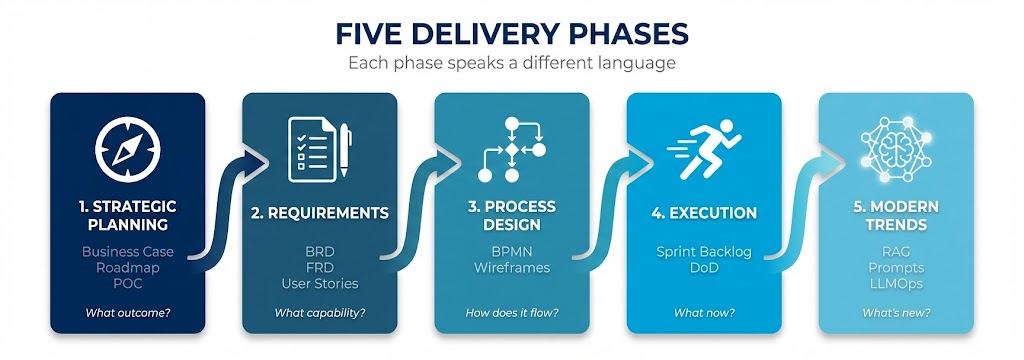 Five phases of cross-functional delivery, each operating at a different altitude with its own language and priorities.
This article, Part 1 of a three-part series, focuses on the first two phases: Strategic Planning and Requirements & Artifacts. These phases quietly shape everything that follows.
Phase 1: Strategic & High-Level Planning
Business Case
What it means:
The financial and strategic rationale for pursuing an initiative. It answers why the work should exist at all, typically through cost-benefit analysis, risk assessment, and expected outcomes.
Why it exists:
To secure funding, align leadership, and define what success actually looks like. It establishes the boundary between committed scope and optional ideas.
How it translates to technology work:
When priorities conflict, the business case provides a reference point. It clarifies which outcomes matter most when trade-offs are unavoidable.
Real scenario:
Midway through a project, an executive asks, “Is this analytics dashboard really necessary?” This usually isn’t a technical question. It’s a check against the business case. If the dashboard doesn’t move the metrics that justified the investment, the concern is valid.
Translation trap:
Delivery teams may treat the business case as a one-time kickoff artifact, while business stakeholders treat it as a living definition of success. When the business case fades from view, teams risk drifting away from the reason the work exists.
Roadmap
What it means:
A time-phased view of major initiatives, dependencies, and strategic direction. It communicates intent, not a feature-by-feature delivery contract.
Why it exists:
To align teams around direction and sequencing without locking decisions that are expected to evolve.
How it translates to technology work:
Dates can be interpreted very differently. Engineering may read them as commitments. Business leaders may see them as directional placeholders. Tension often emerges in the gap between those interpretations.
Translation bridge:
Roadmaps benefit from explicit confidence levels:
- Exploring (low confidence)
- Planning (moderate confidence)
- Committed (high confidence)
Without this context, roadmaps create an illusion of precision that rarely holds.
Feasibility Study / Proof of Concept (POC)
What it means:
A focused investigation to determine whether a solution approach is viable before committing significant resources.
Why it exists:
To test critical assumptions cheaply and reduce risk early.
Translation bridge:
Ask directly: “Are we validating technical feasibility, or validating user value?” The answer changes scope, timeline, and success criteria.
Phase 2: Requirements & Artifacts
BRD (Business Requirements Document)
What it means:
A document capturing business objectives, scope, stakeholders, assumptions, constraints, and success metrics, written from a business perspective.
Why it exists:
To create shared understanding of what needs to be achieved and why, without prescribing how it should be built.
Translation bridge:
User stories should trace back to BRD objectives. When that link is missing, teams risk optimizing locally instead of delivering outcomes.
FRD (Functional Requirements Document)
What it means:
A detailed description of system behavior, defining what the system must do without dictating implementation.
Translation bridge:
A useful test: could this requirement be satisfied with a different technology stack? If not, implementation detail may have leaked into the requirement.
User Story
What it means:
A concise expression of a capability from the user’s perspective, designed to start a conversation rather than finalize a solution.
Common pitfall:
User stories written as technical tasks. When the “user” is the system or developer, the story has lost its purpose.
Acceptance Criteria
What it means:
Clear, testable conditions that define when a user story is complete.
Translation bridge:
Acceptance criteria should guide development, not document it after the fact.
The Context Collapse Problem
The terms themselves aren’t the issue. Context collapse is.
A requirement on a roadmap, in a BRD, in a user story, and in acceptance criteria answers different questions. Using the same word across those layers without clarification creates confusion.
Each role is answering a valid question. Misalignment arises when those answers are treated as interchangeable.
What Helps Translation Hold
- Name the artifact explicitly
- Acknowledge perspective shifts
- Make context visible
Precision doesn’t slow teams down. It prevents rework.
Coming Next
This article focused on strategy and requirements—the layers that define what and why.
Part 2 examines process modeling and execution, where intent meets operational reality.
Part 3 explores emerging AI-era delivery terms reshaping modern teams.
Misalignment is rarely caused by bad intent. More often, it’s caused by shared words carrying different meaning.
Read the series:
→ Part 1: When Words Drift (you are here)
→ Part 2: From Blueprints to Sprints (publishing Jan 22)
→ Part 3: AI-Era Delivery Terms (publishing Jan 23)
Working on cross-functional initiatives? Let’s discuss how translation shows up in your context.