The Decision That Happens Before Strategy
What separates organizations that execute well from those that stay busy: choosing metrics before choosing solutions.
The Pattern Hidden in Plain Sight
Over the past few years working across client engagements, I’ve noticed a recurring pattern in organizations that execute well. It’s not the absence of debate, complexity, or trade-offs—but the presence of one crucial step that happens earlier than most teams expect.
While decisions are often associated with boardrooms, steering committees, and leadership offsites, some of the most influential choices are made earlier and more quietly—when an organization decides what it will measure.
Long before a strategy is operationalized, before solutions are designed, and before execution begins, success is implicitly defined. That definition shapes everything that follows.
Why Business Problems Rarely Fail Where We Think They Do
Most business problems do not arrive neatly packaged. They arrive as symptoms. Revenue growth slows without a clear cause. Operational costs rise despite efficiency initiatives. Customer satisfaction stagnates even as teams work harder. Execution feels busy, but outcomes remain uneven.
The natural response is to act. Launch a program. Implement a tool. Reorganize a team. Action creates momentum, and momentum feels like progress. But in practice, business problems rarely fail because organizations chose the wrong solution. They fail because teams never fully aligned on what success was supposed to look like.
The Core Issue: When success is loosely defined, every solution can be defended. When failure is ambiguous, nothing conclusively fails. And when metrics appear late, they tend to validate decisions that are already emotionally and politically invested.
This is not a failure of intelligence or effort. It is a failure of framing.
The Missing Bridge Between Strategy and Execution
Most organizations are comfortable discussing strategy. Most are equally comfortable mobilizing execution. What often goes missing is the step in between—the translation of intent into measurement.
Strategy is inherently abstract. It speaks in terms of direction: growth, efficiency, experience, resilience, transformation. Execution is concrete. It manifests as initiatives, roadmaps, system changes, and operational plans.
Measurement is the bridge that connects the two.
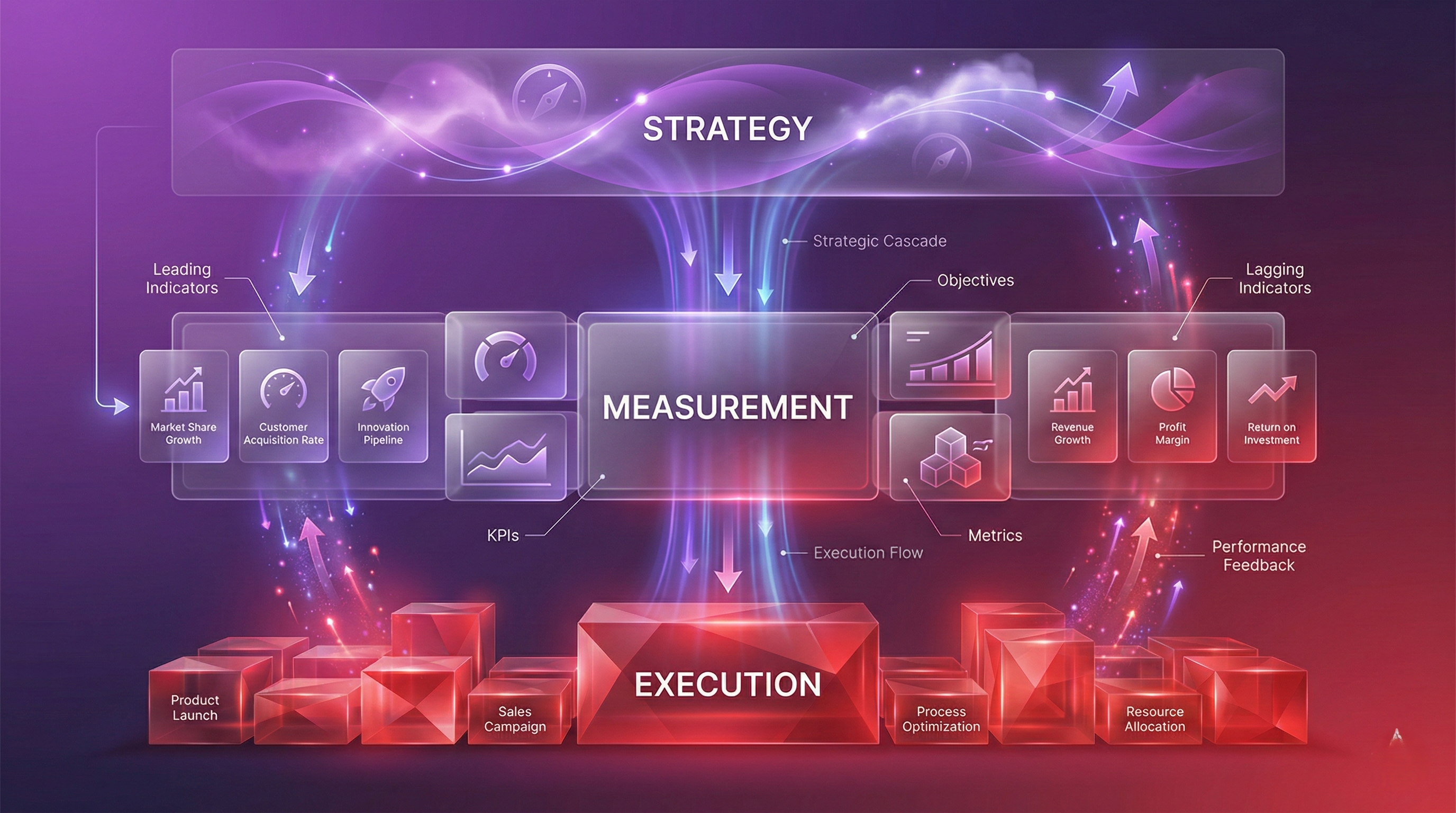 The three-layer relationship: strategy cascades down through measurement, while execution data flows back up
Without that bridge, strategy becomes aspirational rhetoric, and execution becomes a collection of activities without a shared definition of success.
Well before modern dashboards, performance-management frameworks recognized this gap. Their central insight was simple but powerful: objectives must cascade downward, and measures must roll upward. When this relationship holds, execution reinforces intent. When it doesn’t, metrics become noise.
Objectives Clarify Direction. Metrics Enforce Discipline.
One of the most common sources of confusion in organizations is the tendency to conflate objectives with metrics.
They serve related—but distinct—purposes:
- Objectives articulate intent. They describe what the organization is trying to change.
- Metrics introduce discipline. They define how progress and failure will be recognized.
Statements like “improve customer experience” or “increase operational efficiency” are objectives. They are necessary, but insufficient. They point in a direction without constraining behavior.
Metrics do the constraining. They force trade-offs into the open. They determine which actions count as progress and which do not.
This is why metrics provoke discomfort. They reduce flexibility. They limit narrative reinterpretation. And they introduce accountability earlier than many teams expect.
Yet without that discipline, alignment remains superficial.
KPIs Are Not Analytical Artifacts—They Are Design Choices
KPIs are often treated as reporting outputs—numbers to be tracked, dashboards to be reviewed, summaries to be shared upward.
In reality, KPIs are design decisions.
The moment a KPI is defined, it begins shaping:
- What systems are built and how data is modeled
- What behaviors are rewarded or discouraged
- Which trade-offs are acceptable under pressure
- How teams prioritize their time and attention
A business optimized for availability behaves differently from one optimized for efficiency. A team measured on cycle time will make different decisions than one measured on utilization. These differences are not marginal; they compound over time.
Eventually, the KPI stops being something the organization tracks and becomes something the organization is.
This is why KPIs cannot be treated as something to “figure out later.” By the time execution is underway, architecture—technical and behavioral—is already forming.
Measurement Shapes Behavior, Whether We Intend It or Not
Metrics do not simply reflect performance. They influence it.
When a metric becomes a target, behavior bends toward the metric—often in predictable but unintended ways. This is not a moral failing; it is a human one.
People respond rationally to incentives:
- When metrics reward speed, quality may erode
- When they reward volume, judgment may weaken
- When they reward short-term outcomes, long-term consequences are often deferred
Key Insight: The issue is not measurement itself. The issue is poorly chosen proxies—metrics that drift away from the outcomes they are meant to represent.
Well-designed measurement systems anticipate this. They use balance rather than singularity, context rather than absolutism. They acknowledge that no metric is neutral.
The Difference Between Being Data-Rich and Decision-Ready
Many organizations describe themselves as data-driven. In practice, they are data-rich. Dashboards proliferate. Metrics multiply. Reports circulate. Yet decisions remain slow, contested, or reactive.
The reason is subtle: not all metrics are meant to inform decisions.
Some metrics exist to:
- Observe current state
- Diagnose root causes
- Enforce operational constraints
- Guide strategic direction (only a small subset)
When organizations treat every metric as a decision metric, confusion follows. Teams argue over numbers that were never designed to resolve trade-offs. Leaders debate lagging indicators long after meaningful intervention was possible.
Decision readiness does not come from more data. It comes from clarity about which measures matter—and why.
Knowing More Does Not Mean Steering Better
It is entirely possible to know a great deal and still steer poorly. Lagging indicators explain outcomes after the fact. They are essential for accountability, but ineffective for navigation. Leading indicators, by contrast, influence outcomes before they fully materialize.
High-performing organizations are explicit about this distinction. They do not ask lagging metrics to do predictive work they were never designed to do. They rely on metrics that are close to action, sensitive to change, and within the organization’s control.
This distinction separates analytical maturity from analytical overload.
When Metrics Arrive Before Understanding
A common failure pattern in modern organizations is premature measurement.
The sequence looks familiar:
- A problem is identified
- A dashboard is built
- Targets are set
Only later does it become clear that the metric does not reflect the real constraint, that the data lags too far behind decision cycles, or that teams are optimizing around the number rather than the outcome.
At that point, changing the metric feels like retreat. So organizations persist—despite growing discomfort and declining trust in the numbers.
More resilient organizations treat early metrics as hypotheses, not truths. They expect refinement. They revisit assumptions. They allow understanding to mature before locking measurement into place.
Measurement improves alongside insight.
Why KPI Problems Are Often Objective Problems in Disguise
When leaders say they “don’t trust the numbers,” they are rarely questioning data accuracy.
More often, they are questioning relevance.
If a metric cannot clearly answer:
- Are we better off than before?
- Which trade-off did we choose?
- What would failure look like?
Then no amount of analytical rigor will restore confidence.
In these moments, debates about data mask deeper misalignment about intent. The organization never fully agreed on what it was trying to change.
Metrics make that misalignment visible.
Defining KPIs Is a Discipline, Not a Technique
Defining KPIs well is not a technical exercise. It is a discipline.
It requires:
- Sitting with ambiguity longer than feels comfortable
- Resisting the urge to act prematurely
- Making trade-offs explicit rather than implicit
- Accepting that clarity limits flexibility
This discipline is difficult precisely because it slows momentum at the moment action feels most attractive. Yet it is also what distinguishes organizations that move deliberately from those that merely stay busy.
The Quiet Advantage of Deliberate Measurement
Organizations that take measurement seriously do not necessarily move faster. They move with greater coherence.
They argue less about data and more about direction. They surface misalignment earlier, when correction is still inexpensive. They design systems that reinforce intent rather than distort it.
Most importantly, they avoid the gradual erosion of trust that occurs when metrics explain everything yet clarify nothing.
A Closing Reflection
Every business problem eventually collapses into a number.
The only question is whether that number was chosen deliberately—or inherited accidentally.
The quiet decision every successful organization makes is not which solution to pursue, but how success will be recognized when it arrives.
Everything else follows.
Navigating measurement strategy for your organization? Let’s connect to discuss frameworks that translate intent into action.